

Testing Our Architecture Tests with LLM-Generated Counterexamples
Published by Manuel Rivero on 29/06/2026
Introduction.
In a previous post we showed the minimal architecture tests that we are using in a project we are developing for a client.
We used ArchUnit architecture testing library to enforce the design rules. It took us some time to get these tests right. As we said in that post, we think ArchUnit is a complicated beast.
Seeing architecture tests fail.
When we write any kind of test, it’s important to see them fail so that you know that they are actually checking what we want.
In the case of architecture tests this is not so easy to achieve. We need to add code that violates an architectural rule, in order to see it fail, and then, we have to remove that code.
However, provoking those test failures is important to avoid the false security of thinking that we have an architectural test that enforces an architectural rule, but actually enforces nothing.
In summary, the only way to validate that a test actually works is to see it fail, and that includes architecture tests[1].
Mutation testing for architecture tests.
Once architectural tests are in place, we don’t change them often, but in case we need to change one of them, we’ll need to create code that breaks the architectural rule it enforces so that we can see it fail again, and be sure that its new version works.
Doing this process manually is cumbersome and error prone. It would be great to have an automatic way to introduce regressions that break architecture rules so that we can see that our architecture tests work. That would allow us to automatically apply mutation testing to architectural tests.
However, at the time we had this need, there was no mutator for architecture tests in pit, the mutating testing tool we were using for Java.
Mutation testing with LLMs.
When your mutation tool doesn’t have a mutator, using an LLM to generate mutants might be an interesting option. This idea is explained in the post Mutation Testing with AI Agents When Stryker Doesn’t Work. Following the spirit of that post, we decided to use agents to generate code that breaks a given architectural rule.
We started by targeting the architectural tests one by one, prompting the agent to add some new code that violated the rule that the test enforced, telling the agent to check after each trial if the targeted test was failing so it knew whether it had succeeded or it had to keep on trying. After a while we found counterexamples[2] for each architectural rule (architectural mutants).
Offloading determinism with an architectural mutation testing script.
Since, we knew that we’d have to repeat this process every time we had to change an architectural test, we decided to apply the Offload Deterministic pattern, telling the agent to write a script to run mutation testing using the architectural mutants it had previously generated for each of the rules.
Having this script, we could avoid wasting tokens in regenerating architectural mutants every time we needed to change the code of an architectural rule.
If, in the future, we had to add a new rule, we could ask an agent to find a counterexample for the new rule and add it as a mutation to the script.
So, we vibecoded a script that ran mutation testing using the counterexamples found by the LLM, and generated an html report showing all the architectural mutants it tried, saying which ones survived and which ones were killed, and which tests if any were responsible for killing each architectural mutant. The agent named the script archmutant[3].
archmutant.
These are screenshots of archmutant executions and the report it generates:
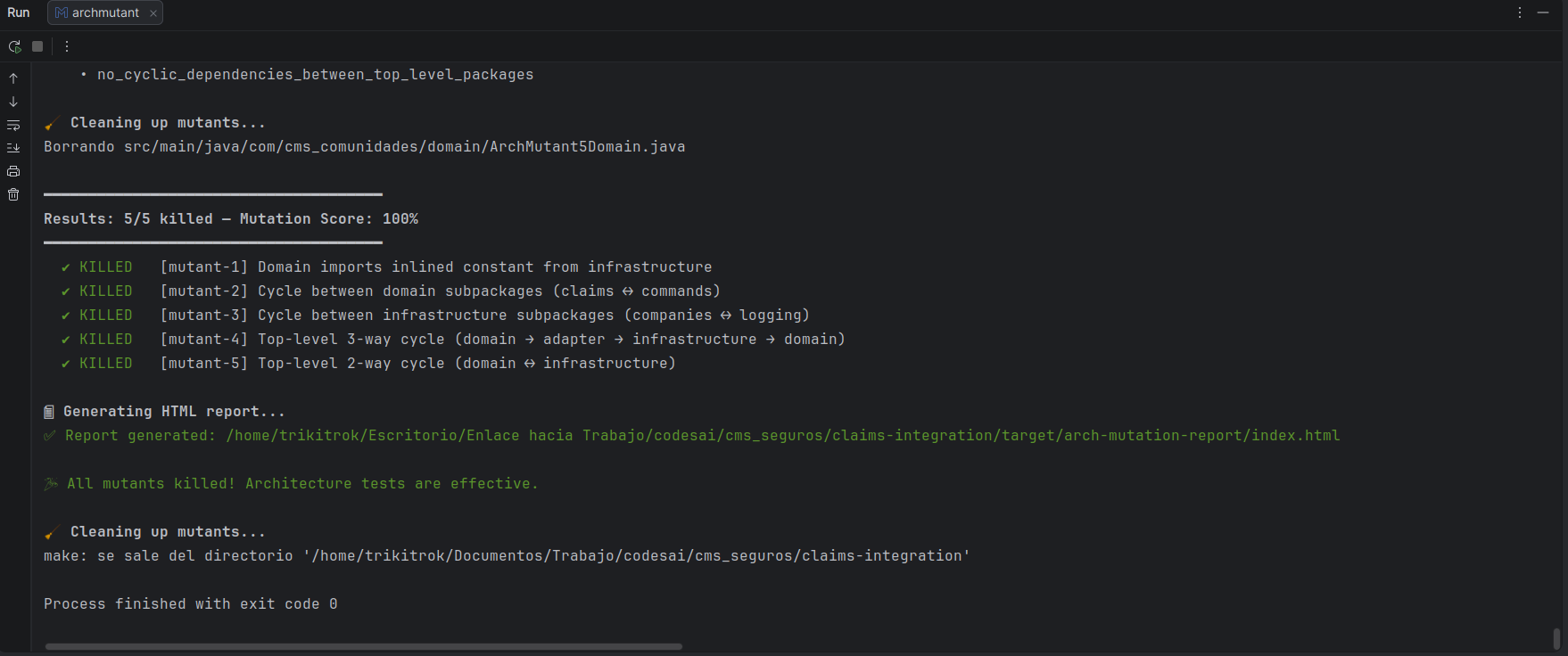
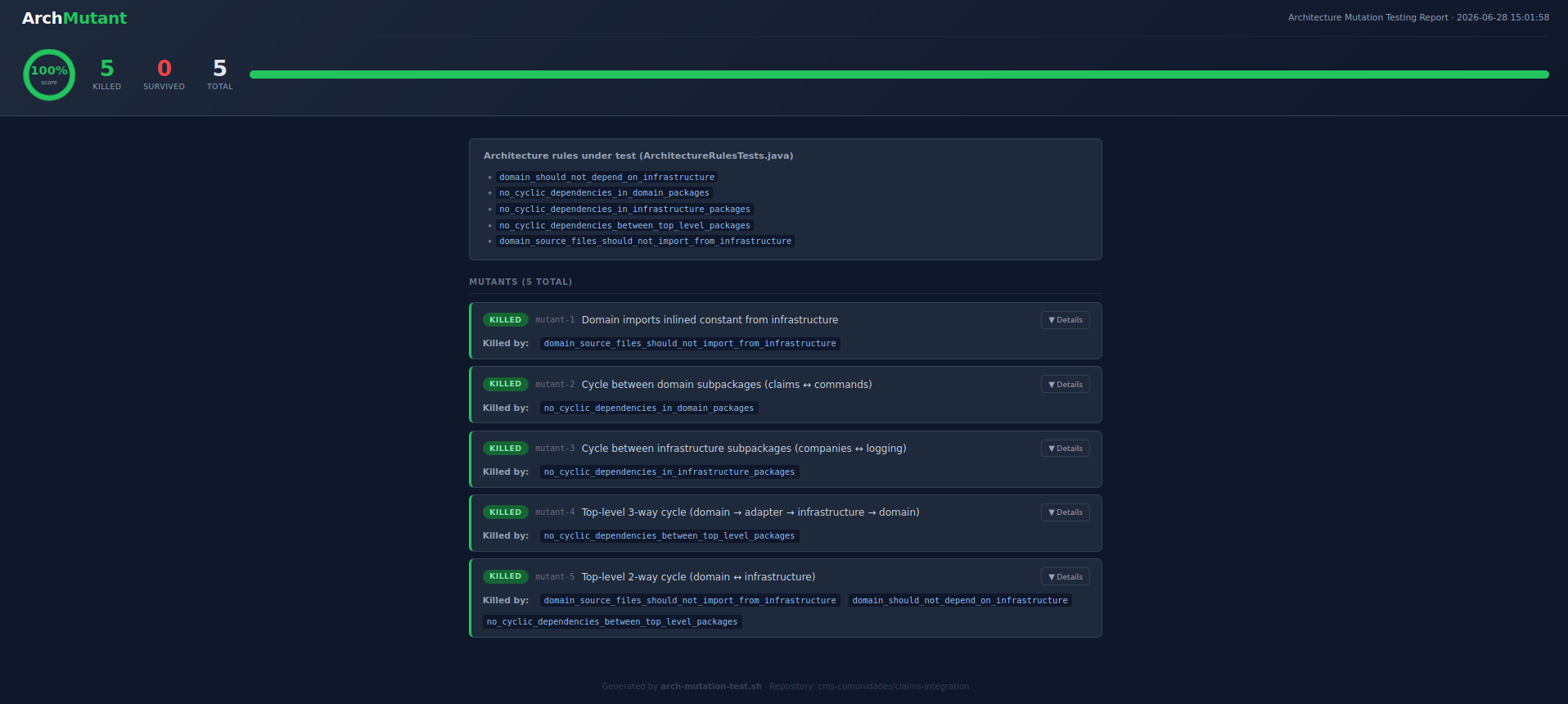
These two screenshots show an execution of archmutant in which all architectural mutants were killed. The report shows a summary of the number of killed, survived and generated mutants, and a percentage of the killed mutants.
It also shows a list of the architectural tests targeted by archmutant (all of them) and a list of the architectural mutants it used. For each killed mutant, the report tells which tests killed it (the tests the given architectural mutant made fail).
Remember that these architectural mutants were generated previously by an LLM and stored in files. archmutant is using those “hardcoded” architectural mutants to avoid both indeterminism and wasting tokens each time we run it[4].
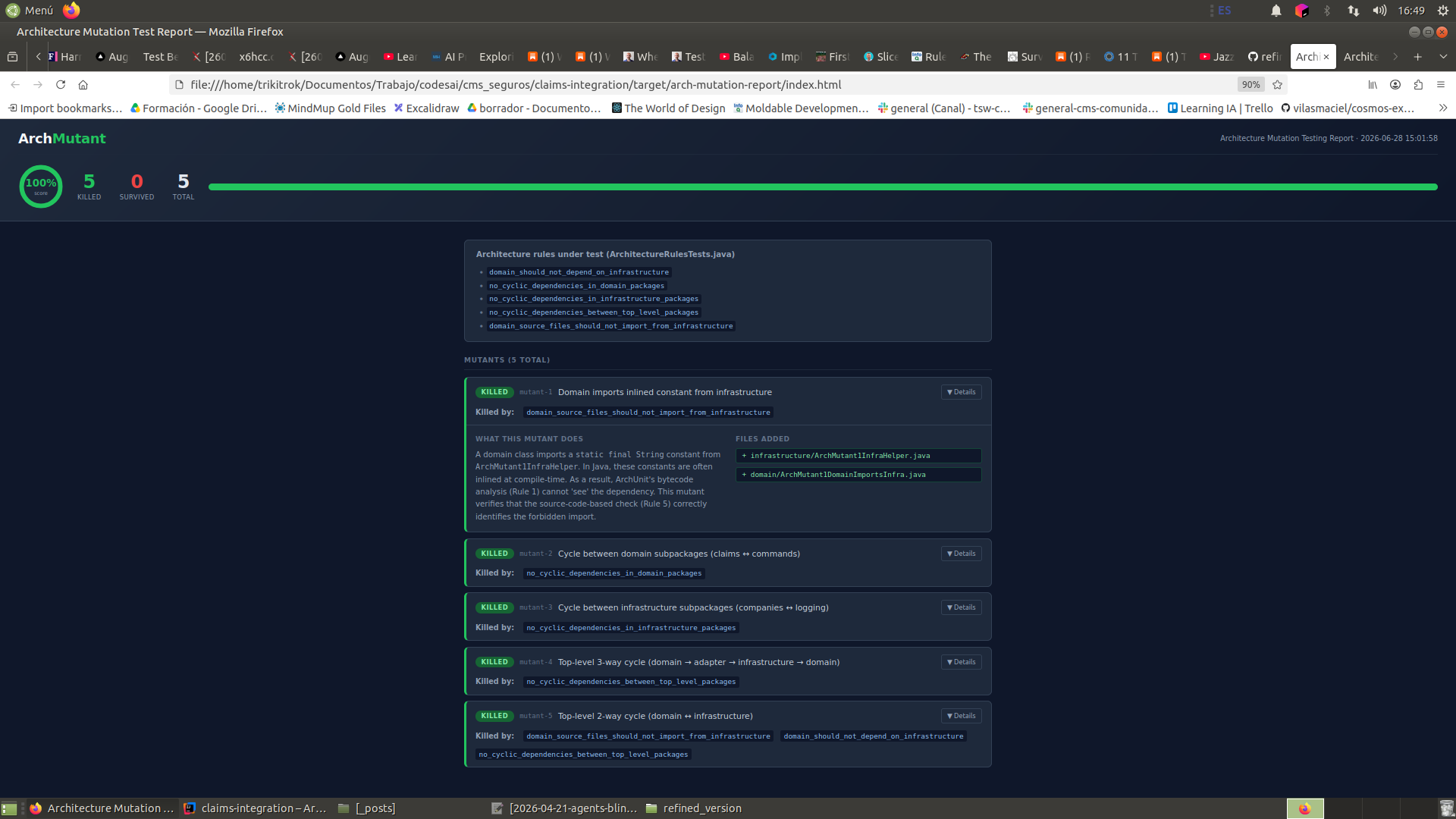
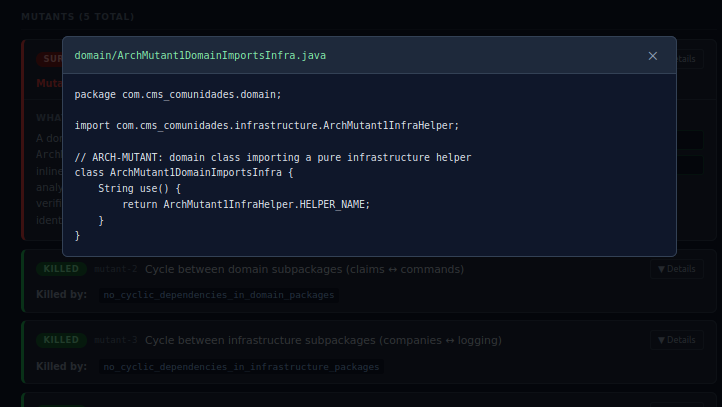
If we click on the Details toggle on a given architectural mutant the report shows us what that mutant does in order to break a rule, and the files added to the project to generate the architectural mutant. We can also click on the files to see their code.
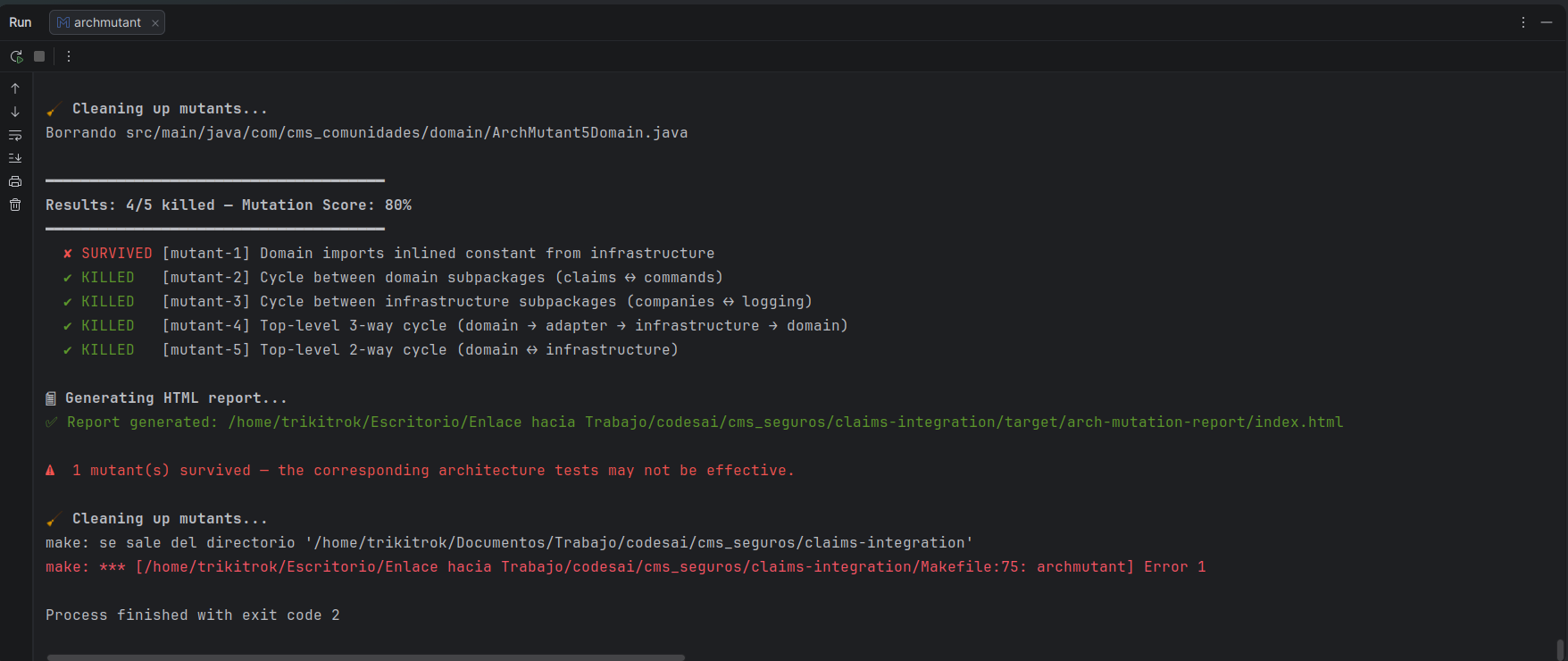
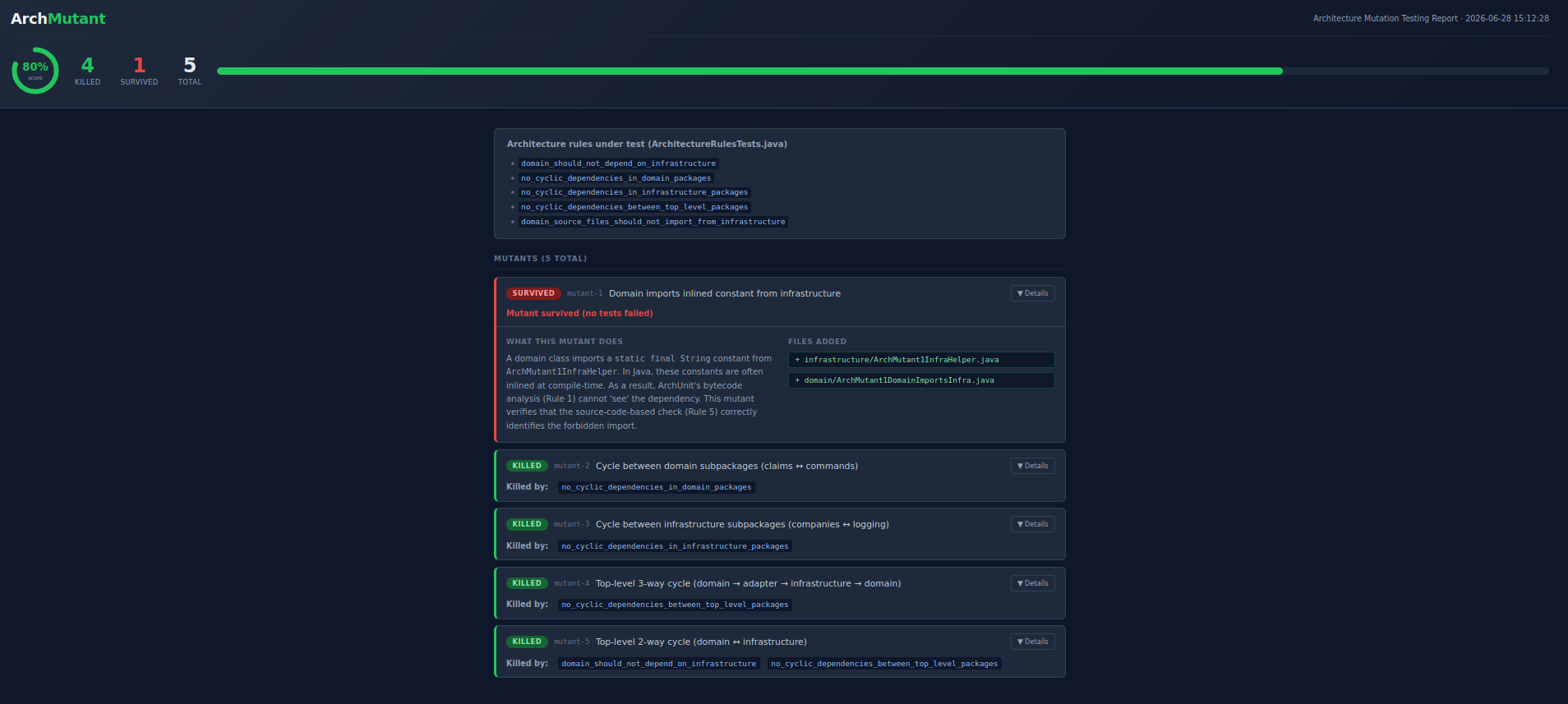
Next we show screenshots corresponding to an execution of archmutant in which an architectural mutant survived.
Refining our architectural tests.
These are our initial architecture tests:
We used an agent and archmutant to refine them. In fact the agent found a loophole in one of the rules written with ArchUnit.
The loophole.
The existing domain_should_not_depend_on_infrastructure architectural test did not detect an architectural violation in the generated mutant ArchMutant1DomainImportsInfra.java:
Even though we were importing code from infrastructure this domain file the architectural test was passing. The ArchUnit rule was not working.
After some research, we discovered this was due to Java compile-time constant inlining [5] and the fact that ArchUnit is entirely bytecode-based.
ArchMutant1InfraHelper.HELPER_NAME was declared as a static final String:
ArchMutant1InfraHelper.HELPER_NAME is a compile-time constant (a static final primitive or String initialized with a constant expression) whose value, per the Java Language Specification, gets inlined by the compiler directly into the calling class’s bytecode. As a result, the compiled .class file for ArchMutant1DomainImportsInfra contains no reference whatsoever to ArchMutant1InfraHelper.
As we said above, ArchUnit rules are entirely bytecode-based, this means that it analyzes .class files, not .java source files. All of its dependency-checking APIs (dependOnClassesThat, accessClassesThat, directlyDependOnClassesThat, etc.) operate on what the JVM actually sees at runtime.
Since the constant ArchMutant1InfraHelper.HELPER_NAME was inlined by the compiler, there was nothing in the bytecode for ArchUnit to detect, which meant that the domain_should_not_depend_on_infrastructure test didn’t detect any architectural violation.
This counterexample led us to improve our architecture tests.
Having a script like archmutant allowed us to iterate the architectural tests with an agent faster and spend less tokens because the mutation testing runs were deterministic. The agent only generated new versions of the architecture tests until we got to a version of the tests that killed all the architectural mutants.
This is the current version of our architectural tests that kills all the architectural mutants:
Conclusions.
Architecture tests can enforce some important design constraints, but, like any other tests, confidence in them is only justified if we have seen them fail. In our experience, architectural tests are not special in this regard: they also benefit from having counterexamples that prove they are actually checking what we think they are checking.
Using an LLM to generate mutants might be a useful technique to apply mutation testing when no suitable mutator exists. We would not claim that this approach is exhaustive or that it can replace a dedicated mutation testing tool. We see it as a complementary technique, we might rely on, to apply mutation testing to cases we consider important for which no suitable mutator exists yet in our mutation testing tool.
In the case of architectural tests, at the time we were working on this project, we didn’t know of any mutation testing tool for Java code that included architectural mutators, so using agents to generate architectural mutants turned out to be a practical way of finding counterexamples for the architectural rules enforced by our architectural tests.
Persisting the generated mutants and replaying them using a script (called archmutant by the agent) also gave us a more repeatable workflow. This was an application of the Offload Deterministic pattern. By separating the nondeterministic task of discovering mutants from the deterministic task of replaying them, we can iterate on our architecture tests without repeatedly spending tokens or relying on the model to rediscover the same cases.
Perhaps the most interesting result was that the process uncovered a real loophole in one of our ArchUnit rules. The issue was due to Java compile-time constant inlining and ArchUnit analysis being bytecode-based. Without the surviving generated counterexample (architectural mutant), we might have continued believing that the rule was enforcing something that, in practice, it was not.
The generated architectural mutant and archmutant allowed us to refine our architectural tests in a deterministic manner without spending any more tokens in generating mutations.
We see architectural mutation testing as an additional feedback mechanism that can improve how confident we are on our architecture tests actually checking what we think they are checking. It has helped us improve our tests and challenge some of our assumptions, and we suspect there may be other situations where combining mutation testing ideas with LLM-generated counterexamples can provide similar benefits.
Acknowledgements.
I’d like to thank Fernando Aparicio, Emmanuel Valverde Ramos and Fran Reyes for giving me feedback about several drafts of this post.
Finally, I’d also like to thank Studio Saiz Studio Saiz for the photo.
References.
-
Our Architectural Guardrails for AI-Generated Code, Manuel Rivero
-
Mutation Testing with AI Agents When Stryker Doesn’t Work, Alexander Opalic
Notes.
[1] This is even more important if you don’t know well how an architecture testing library works.
This happened to us using AI to write the architecture tests for a TypeScript kata. The agent hallucinated architecture tests that didn’t work at all, and we embarrassingly took some time to realize what was happening.
After intentionally introducing code to break each of the rules, we detected and fixed the problem. In the end, we switched to using a different architecture testing library with better documentation.
[2] Counterexample here means an example of code that breaks an architectural rule.
[3] You can have a look at the code of archmutant here. It works only for our project, and it’s far from being a general tool that can be applied to any project, even furthest to be suitable to be open sourced, or integrated with an existing mutation tool.
It’s only something that gave as value in our project, and is serving as an example to illustrate two ideas:
-
Using LLMs to generate mutants when your mutation tool does not have a suitable mutator for what you want to check.
-
How powerful the Offload Deterministic pattern can be (both to save time and tokens).
[4] This is an application of the Offload Deterministic pattern.
[5] Read a more detailed explanation of compile-time constants, and how they are inlined into the classes that reference them, in What Are Compile-Time Constants in Java?.